
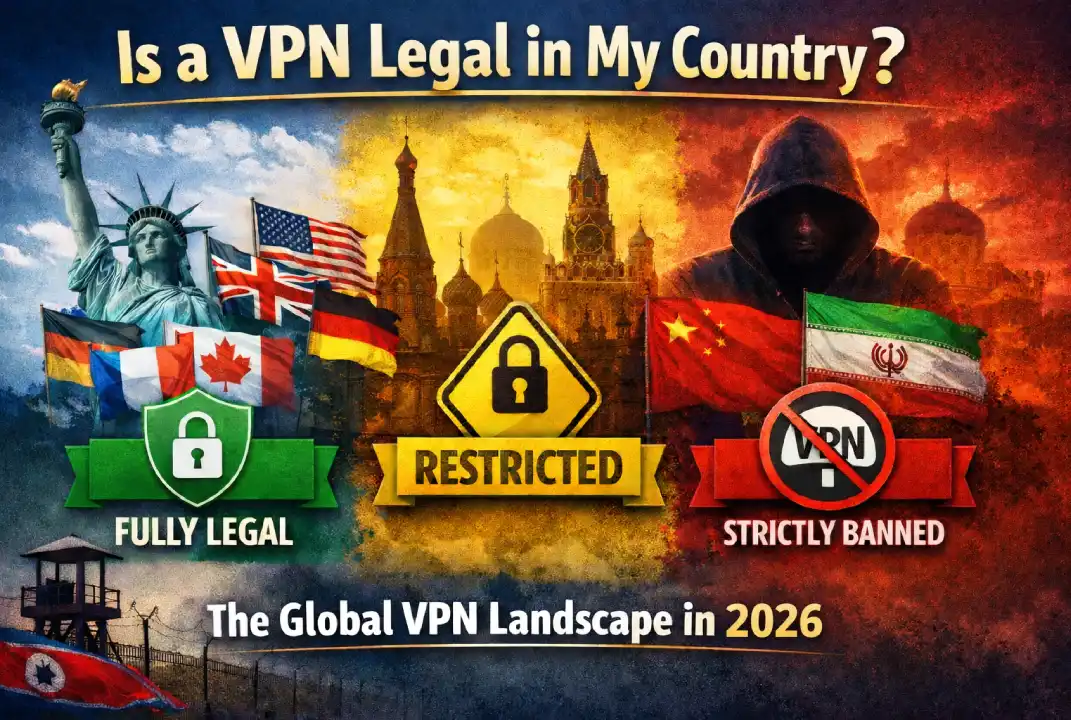
Is a VPN Legal
In My Country?
Virtual Private Networks (VPNs) are foundational tools for online privacy. But legality varies wildly depending on your global coordinates. Ironically, the jurisdictions that require VPNs the most are often the ones actively attempting to outlaw them. Here is the definitive 2026 breakdown.

By Andreas Lazarou, Lead Security Engineer
Technically Reviewed by the VPNDeals Team • Updated February 2026
In short: Using a Virtual Private Network (VPN) is 100% legal in the vast majority of countries around the world (including the US, UK, Canada, and the EU). However, a small number of authoritarian regimes strictly ban or heavily regulate their use to maintain state censorship and monitor civilian internet traffic.
Global Censorship Telemetry
Citizens facing active internet restrictions
Countries with mandated ISP data logging
Maximum fines in absolute blackout zones
🌍 The 2026 Global Legality Index
Search our comprehensive database to find out if using a VPN is legal in your country. We track ISP logging laws, government censorship, and strict anti-VPN legislation worldwide.
| Country | VPN Legality | Censorship & Legal Context | Required VPN Tech |
|---|---|---|---|
| 🇦🇫 Afghanistan | Strictly Banned | Under current Taliban rule, the internet is heavily monitored and censored. Using a VPN to bypass state filters on social media is illegal and highly dangerous. | Advanced Obfuscation |
| 🇦🇱 Albania | 100% Legal | Fully legal. The government does not restrict internet access or encryption tools. Safe for torrenting and privacy. | Standard Encryption |
| 🇩🇿 Algeria | Monitored | Legal, but the state actively monitors telecommunications and occasionally blocks social media platforms during national exams or protests. | Strict No-Logs |
| 🇦🇩 Andorra | 100% Legal | Fully legal. Used primarily by residents to bypass regional streaming restrictions from neighboring France and Spain. | Streaming Optimized |
| 🇦🇴 Angola | 100% Legal | Legal. The government passed cybercrime laws, but they do not outlaw VPNs. Used mainly for corporate security and basic privacy. | Standard Encryption |
| 🇦🇬 Antigua & Barbuda | 100% Legal | Fully legal with no restrictions on cryptographic routing or internet freedom. | Standard Encryption |
| 🇦🇷 Argentina | 100% Legal | Fully legal. Frequently used by citizens to access foreign financial platforms and secure transactions against economic surveillance. | Kill Switch |
| 🇦🇲 Armenia | 100% Legal | Legal. Internet is largely free, though brief social media blocks have occurred during conflicts. VPNs guarantee uninterrupted access. | Standard Encryption |
| 🇦🇺 Australia | 100% Legal | Legal, but the Assistance and Access Act allows authorities to demand encrypted data. A verified strict no-logs policy is mandatory for privacy. | RAM-Only Servers |
| 🇦🇹 Austria | 100% Legal | Legal. Strong EU privacy laws apply, but VPNs are actively used to bypass ISP data retention mandates and access global media. | High-Speed Protocols |
| 🇦🇿 Azerbaijan | Censored | Legal to possess, but the government actively blocks independent news and throttles internet speeds during political events. | Obfuscated Servers |
| 🇧🇸 Bahamas | 100% Legal | Fully legal. Unrestricted internet access, commonly used to secure public Wi-Fi connections for tourists and residents. | Standard Encryption |
| 🇧🇭 Bahrain | Heavily Restricted | Legal to use, but ISPs utilize deep packet inspection to filter thousands of political and religious websites. High risk for bypassing filters. | Obfuscation (Stealth) |
| 🇧🇩 Bangladesh | Restricted | Legal, but the government frequently orders ISPs to block news portals and social platforms. VPNs are essential for free information flow. | Obfuscated Servers |
| 🇧🇧 Barbados | 100% Legal | Fully legal with no restrictions on internet freedom or encryption. | Standard Encryption |
| 🇧🇾 Belarus | Strictly Banned | Using any tool, including proxies or Tor, to bypass state web filtering is explicitly illegal. ISPs are legally required to track violators. | Advanced Obfuscation |
| 🇧🇪 Belgium | 100% Legal | Fully legal. Ideal for bypassing geo-blocks and protecting personal data from EU-mandated ISP metadata retention laws. | Strict No-Logs |
| 🇧🇿 Belize | 100% Legal | Fully legal. Sometimes used to bypass local ISP blocks on VoIP services like Skype and WhatsApp. | Standard Encryption |
| 🇧🇯 Benin | 100% Legal | Legal. However, the government has briefly shut down the internet during elections. VPNs help maintain access to global servers. | Standard Encryption |
| 🇧🇹 Bhutan | 100% Legal | Legal. No reported state censorship on standard internet browsing or cryptographic routing. | Standard Encryption |
| 🇧🇴 Bolivia | 100% Legal | Fully legal. Used primarily for privacy and unlocking US-based streaming catalogs. | Streaming Optimized |
| 🇧🇦 Bosnia & Herzegovina | 100% Legal | Fully legal. Internet access is mostly unrestricted, though cybercrime laws are evolving. | Standard Encryption |
| 🇧🇼 Botswana | 100% Legal | Legal. Unrestricted access, commonly used to prevent tracking and bypass regional geo-blocks. | Standard Encryption |
| 🇧🇷 Brazil | 100% Legal | Legal. However, judges frequently issue nationwide bans on platforms like X or Telegram. VPNs are critical for continuous access. | Geo-Spoofing |
| 🇧🇳 Brunei | Censored | Legal to use, but the state strictly monitors online content and penalizes anything deemed offensive. A strict zero-logs policy is necessary. | Strict No-Logs |
| 🇧🇬 Bulgaria | 100% Legal | Fully legal. Internet is largely free, commonly used for high-speed P2P torrenting and privacy. | P2P Optimized |
| 🇧🇫 Burkina Faso | Restricted | Legal, but internet blackouts and social media blocks have occurred during military unrest. | Standard Encryption |
| 🇧🇮 Burundi | Monitored | Legal. The state monitors communications heavily and has blocked social platforms (WhatsApp, X) during elections. | Obfuscated Servers |
| 🇨🇻 Cabo Verde | 100% Legal | Fully legal with no restrictions. High degree of internet freedom. | Standard Encryption |
| 🇰🇭 Cambodia | Monitored | Legal, but the government established a National Internet Gateway (NIG) to route and monitor all traffic. VPNs bypass this massive surveillance node. | Obfuscated Servers |
| 🇨🇲 Cameroon | 100% Legal | Legal, though the government has a history of long-term internet shutdowns in specific regions. | Standard Encryption |
| 🇨🇦 Canada | 100% Legal | Fully legal. Widely used to bypass geo-blocks and prevent ISP bandwidth throttling during high-speed streaming or P2P torrenting. | High-Speed Protocols |
| 🇨🇫 Central African Republic | 100% Legal | Legal, though overall internet infrastructure is limited and occasional monitoring occurs. | Standard Encryption |
| 🇹🇩 Chad | Restricted | Legal. The government has historically blocked social media for over a year at a time. VPNs are standard for bypassing these blocks. | Obfuscated Servers |
| 🇨🇱 Chile | 100% Legal | Fully legal. Strong net neutrality laws exist, making Chile a secure environment for VPN utilization. | Standard Encryption |
| 🇨🇳 China | Strictly Banned | Only state-approved (monitored) VPNs are legal. The Great Firewall actively severs OpenVPN traffic. Unauthorized use carries fines up to $140,000. | Advanced Obfuscation |
| 🇨🇴 Colombia | 100% Legal | Legal. Internet is largely free, but users rely on VPNs to prevent ISP tracking and access US-based streaming catalogs. | Streaming Optimized |
| 🇰🇲 Comoros | 100% Legal | Legal. Telecoms are largely state-owned, so VPNs are recommended for basic privacy. | Standard Encryption |
| 🇨🇬 Congo (Republic) | 100% Legal | Legal, though internet and SMS have been suspended during sensitive political periods. | Standard Encryption |
| 🇨🇩 Congo (DRC) | Restricted | Legal, but the government frequently orders ISPs to cut internet access or block social networks during protests. | Obfuscated Servers |
| 🇨🇷 Costa Rica | 100% Legal | Fully legal. Highly secure environment with constitutional protections for privacy. | Standard Encryption |
| 🇭🇷 Croatia | 100% Legal | Fully legal. Complies with EU internet laws. Widely used for bypassing sports broadcast geo-blocks. | Streaming Optimized |
| 🇨🇺 Cuba | Monitored | Internet access is heavily restricted and state-controlled. VPNs are legal but networks actively attempt to drop encrypted packet traffic. | Stealth Protocols |
| 🇨🇾 Cyprus | 100% Legal | Fully legal. Unrestricted access, standardly used to secure public connections. | Standard Encryption |
| 🇨🇿 Czechia (Czech Republic) | 100% Legal | Fully legal. Safe jurisdiction for internet freedom with no significant censorship. | Standard Encryption |
| 🇩🇰 Denmark | 100% Legal | Legal, but Denmark requires extensive data logging from ISPs. VPNs are heavily used to protect consumer privacy from state surveillance. | Strict No-Logs |
| 🇩🇯 Djibouti | 100% Legal | Legal. State-owned ISP monopolizes internet, making encryption vital for privacy. | Standard Encryption |
| 🇩🇲 Dominica | 100% Legal | Fully legal with complete internet freedom. | Standard Encryption |
| 🇩🇴 Dominican Republic | 100% Legal | Fully legal. No government censorship. Used to protect data on public networks. | Standard Encryption |
| 🇪🇨 Ecuador | 100% Legal | Legal. Used to bypass geo-blocks and maintain privacy under changing cyber laws. | Standard Encryption |
| 🇪🇬 Egypt | Throttled | Legal to possess, but the government blocks VoIP services and thousands of news sites. OpenVPN protocols are frequently throttled. | WireGuard / Stealth |
| 🇸🇻 El Salvador | 100% Legal | Legal. However, rising digital surveillance concerns make zero-log VPNs highly recommended. | Strict No-Logs |
| 🇬🇶 Equatorial Guinea | Monitored | Legal, but internet is tightly controlled by the state and self-censorship is common. | Obfuscated Servers |
| 🇪🇷 Eritrea | Strictly Banned | Internet access is almost non-existent for citizens. The state completely controls all communications. VPN usage is heavily criminalized. | N/A |
| 🇪🇪 Estonia | 100% Legal | Fully legal. One of the most digitally advanced nations with high internet freedom. | Standard Encryption |
| 🇸🇿 Eswatini | 100% Legal | Legal. Occasional internet disruptions during protests mean VPNs are used to ensure secure connections. | Standard Encryption |
| 🇪🇹 Ethiopia | Censored | Legal, but the government frequently shuts down the internet or blocks social platforms (Facebook, Telegram) during conflicts. | Obfuscated Servers |
| 🇫🇯 Fiji | 100% Legal | Fully legal. Internet is free of government censorship. | Standard Encryption |
| 🇫🇮 Finland | 100% Legal | Fully legal. High standard of privacy laws and net neutrality. | Standard Encryption |
| 🇫🇷 France | 100% Legal | Completely legal. French surveillance laws (LPM) are expanding, making cryptographic routing essential for basic digital privacy. | WireGuard Protocol |
| 🇬🇦 Gabon | 100% Legal | Legal. Internet blackouts have occurred post-election, but VPN usage remains unrestricted. | Standard Encryption |
| 🇬🇲 Gambia | 100% Legal | Fully legal. Internet freedom has improved significantly, no major restrictions. | Standard Encryption |
| 🇬🇪 Georgia | 100% Legal | Fully legal. Very free internet landscape. | Standard Encryption |
| 🇩🇪 Germany | 100% Legal | Legal and widely used. Germany has strict anti-piracy laws (Abmahnung fines); users rely on VPNs for secure, anonymous P2P file sharing. | P2P Optimized |
| 🇬🇭 Ghana | 100% Legal | Fully legal. Free internet environment, used mainly for privacy and streaming. | Standard Encryption |
| 🇬🇷 Greece | 100% Legal | Fully legal. Adheres to EU privacy laws. | Standard Encryption |
| 🇬🇩 Grenada | 100% Legal | Fully legal with complete internet freedom. | Standard Encryption |
| 🇬🇹 Guatemala | 100% Legal | Fully legal. No government censorship of standard internet routing. | Standard Encryption |
| 🇬🇳 Guinea | 100% Legal | Legal, though social media has been periodically restricted during political crises. | Obfuscated Servers |
| 🇬🇼 Guinea-Bissau | 100% Legal | Fully legal with no major censorship reported. | Standard Encryption |
| 🇬🇾 Guyana | 100% Legal | Fully legal. Sometimes used to bypass local ISP VoIP blocking. | Standard Encryption |
| 🇭🇹 Haiti | 100% Legal | Fully legal with no state restrictions on encryption tools. | Standard Encryption |
| 🇭🇳 Honduras | 100% Legal | Fully legal. Unrestricted internet environment. | Standard Encryption |
| 🇭🇺 Hungary | 100% Legal | Legal. Independent news consumption via VPN is common due to media consolidation. | Standard Encryption |
| 🇮🇸 Iceland | 100% Legal | Fully legal. One of the best jurisdictions in the world for data privacy and net neutrality. | Standard Encryption |
| 🇮🇳 India | Restricted | Legal to use, but the CERT-In directive forces companies with physical Indian servers to store user data for 5 years. Use virtual servers instead. | Virtual Servers |
| 🇮🇩 Indonesia | Censored | Legal, but tightening. The government maintains a blocklist (Trust+ Positif) of 800,000+ sites and actively blocks “free” VPN IP addresses. | Dedicated IP |
| 🇮🇷 Iran | Strictly Banned | Possession of unauthorized circumvention tools is illegal. The state forces users onto a monitored National Intranet by blocking global IP ranges. | Shadowsocks / V2Ray |
| 🇮🇶 Iraq | Strictly Banned | VPNs were officially banned to prevent terrorism communications. The ban remains, and the government frequently enacts nationwide internet blackouts. | Stealth Protocols |
| 🇮🇪 Ireland | 100% Legal | Fully legal. Governed by strong EU data protection laws (GDPR). | Standard Encryption |
| 🇮🇱 Israel | 100% Legal | Fully legal. High rates of cyber-attacks make enterprise-grade encryption standard practice for ordinary citizens. | AES-256 Encryption |
| 🇮🇹 Italy | 100% Legal | Legal. Used for unblocking global sports broadcasts (Serie A) and protecting data from ISP tracking under EU data laws. | High-Speed Protocols |
| 🇯🇲 Jamaica | 100% Legal | Fully legal with complete internet freedom. | Standard Encryption |
| 🇯🇵 Japan | 100% Legal | Legal with no restrictions. Highly popular for accessing Western streaming catalogs and securing connections on public Tokyo Wi-Fi. | Streaming Optimized |
| 🇯🇴 Jordan | Censored | Legal to use, but the state has recently expanded cybercrime laws to block VoIP and social media. VPNs are used to evade these local ISP bans. | Obfuscated Servers |
| 🇰🇿 Kazakhstan | Censored | Legal, but the government requires ISPs to install a root certificate to intercept HTTPS traffic. VPNs are the only way to bypass this MITM attack. | Obfuscation (Stealth) |
| 🇰🇪 Kenya | 100% Legal | Fully legal. Strong internet infrastructure, widely used for privacy. | Standard Encryption |
| 🇰🇮 Kiribati | 100% Legal | Fully legal. No government restrictions on internet. | Standard Encryption |
| 🇰🇼 Kuwait | Censored | Legal, but the Ministry of Communication heavily filters content (political, religious, adult). Using VPNs to bypass state morality filters is risky. | Obfuscated Servers |
| 🇰🇬 Kyrgyzstan | 100% Legal | Legal. Relatively free internet compared to neighboring states. | Standard Encryption |
| 🇱🇦 Laos | Monitored | Legal, but the government enforces strict censorship on news and political discourse. Zero-logs policies are vital. | Strict No-Logs |
| 🇱🇻 Latvia | 100% Legal | Fully legal. Strong European privacy protections. | Standard Encryption |
| 🇱🇧 Lebanon | Restricted | Legal. The government attempts to block certain foreign websites and VoIP. VPNs are heavily used by citizens to maintain communication. | Obfuscated Servers |
| 🇱🇸 Lesotho | 100% Legal | Fully legal with no reported censorship. | Standard Encryption |
| 🇱🇷 Liberia | 100% Legal | Legal. Temporary social media blocks have happened in the past, but general routing is unrestricted. | Standard Encryption |
| 🇱🇾 Libya | Censored | Legal, but the internet landscape is heavily fragmented and controlled by competing factions. Encryption is highly recommended for safety. | Kill Switch |
| 🇱🇮 Liechtenstein | 100% Legal | Fully legal. World-class privacy environment. | Standard Encryption |
| 🇱🇹 Lithuania | 100% Legal | Fully legal. High-speed infrastructure and free internet access. | Standard Encryption |
| 🇱🇺 Luxembourg | 100% Legal | Fully legal. Excellent data protection laws. | Standard Encryption |
| 🇲🇬 Madagascar | 100% Legal | Fully legal with no major restrictions. | Standard Encryption |
| 🇲🇼 Malawi | 100% Legal | Legal. Cyber security laws exist but do not ban encrypted traffic. | Standard Encryption |
| 🇲🇾 Malaysia | Censored | Legal. The government frequently blocks news portals and blogs that criticize authorities. VPNs easily bypass these ISP-level blocks. | Strict No-Logs |
| 🇲🇻 Maldives | 100% Legal | Legal. Used mostly for unblocking global streaming content. | Standard Encryption |
| 🇲🇱 Mali | 100% Legal | Legal. Occasional social media disruptions occur during unrest. | Standard Encryption |
| 🇲🇹 Malta | 100% Legal | Fully legal. Strong EU privacy laws. | Standard Encryption |
| 🇲🇭 Marshall Islands | 100% Legal | Fully legal with complete internet freedom. | Standard Encryption |
| 🇲🇷 Mauritania | Restricted | Legal, but state-ordered internet blackouts are common during elections or protests. | Obfuscated Servers |
| 🇲🇺 Mauritius | 100% Legal | Fully legal. Open and unrestricted internet. | Standard Encryption |
| 🇲🇽 Mexico | 100% Legal | Legal. Used heavily to bypass regional streaming restrictions and protect against rising cybercrime on public networks. | AES-256 Encryption |
| 🇫🇲 Micronesia | 100% Legal | Fully legal with no government restrictions. | Standard Encryption |
| 🇲🇩 Moldova | 100% Legal | Fully legal. Unrestricted access. | Standard Encryption |
| 🇲🇨 Monaco | 100% Legal | Fully legal with a high standard of data protection. | Standard Encryption |
| 🇲🇳 Mongolia | 100% Legal | Fully legal. Free internet environment. | Standard Encryption |
| 🇲🇪 Montenegro | 100% Legal | Fully legal with no major restrictions. | Standard Encryption |
| 🇲🇦 Morocco | Censored | Legal, but independent journalism is heavily monitored and some VoIP services have been historically blocked by state telecoms. | Obfuscated Servers |
| 🇲🇿 Mozambique | 100% Legal | Legal. Unrestricted access for standard browsing. | Standard Encryption |
| 🇲🇲 Myanmar (Burma) | Strictly Banned | The military junta drafted a cybersecurity bill criminalizing VPN usage with up to 3 years in prison. The internet is heavily monitored and frequently shut down. | Shadowsocks |
| 🇳🇦 Namibia | 100% Legal | Fully legal. Internet access is largely unrestricted, though infrastructure is still developing. | Standard Encryption |
| 🇳🇷 Nauru | 100% Legal | Legal. Historically, the government temporarily blocked Facebook, but VPNs freely bypass such ISP-level bans. | Standard Encryption |
| 🇳🇵 Nepal | 100% Legal | Fully legal. The government has previously attempted to ban platforms like TikTok; VPNs are essential for guaranteed access. | Standard Encryption |
| 🇳🇱 Netherlands | 100% Legal | Legal. The Netherlands is a global privacy haven and hosts many premium VPN servers due to favorable data retention laws. | Standard Encryption |
| 🇳🇿 New Zealand | 100% Legal | Fully legal. As a member of the 5-Eyes intelligence alliance, citizens heavily rely on zero-log VPNs for digital privacy. | Strict No-Logs |
| 🇳🇮 Nicaragua | Monitored | Legal, but a controversial cybercrime law heavily penalizes “fake news,” leading to massive self-censorship. VPNs are critical for anonymous journalism. | Strict No-Logs |
| 🇳🇪 Niger | 100% Legal | Legal. Social media disruptions occur during political instability, making encryption tools necessary. | Standard Encryption |
| 🇳🇬 Nigeria | Restricted | Legal. The government previously banned X (Twitter) for months. Citizens routinely deploy VPNs to evade state telecom blocks. | Standard Encryption |
| 🇰🇵 North Korea | Absolute Blackout | Global internet access is strictly forbidden for ordinary citizens. Attempting to use a VPN or smuggle foreign media is punishable by severe imprisonment. | N/A |
| 🇲🇰 North Macedonia | 100% Legal | Fully legal with complete internet freedom. | Standard Encryption |
| 🇳🇴 Norway | 100% Legal | Fully legal. Excellent data privacy laws, largely outside of standard EU data retention directives. | Standard Encryption |
| 🇴🇲 Oman | Strictly Banned | Personal VPN use is entirely illegal. Only institutions explicitly permitted by the Telecommunications Regulatory Authority may use them. Individuals face $1,300 fines. | Stealth / Shadowsocks |
| 🇵🇰 Pakistan | Restricted | VPNs must be officially registered with the PTA (Pakistan Telecommunication Authority). Unregistered encrypted traffic is subject to blocking and throttling. | Obfuscated Servers |
| 🇵🇼 Palau | 100% Legal | Fully legal with no government restrictions. | Standard Encryption |
| 🇵🇸 Palestine | 100% Legal | Legal, though infrastructure is heavily controlled by Israeli telecoms, making encrypted routing vital for privacy. | Standard Encryption |
| 🇵🇦 Panama | 100% Legal | Fully legal. A prime jurisdiction for VPN headquarters due to zero mandatory data retention laws. | Standard Encryption |
| 🇵🇬 Papua New Guinea | 100% Legal | Fully legal. Free internet environment. | Standard Encryption |
| 🇵🇾 Paraguay | 100% Legal | Fully legal with no restrictions. | Standard Encryption |
| 🇵🇪 Peru | 100% Legal | Fully legal. Used widely to bypass geo-blocks and secure public Wi-Fi access. | Standard Encryption |
| 🇵🇭 Philippines | 100% Legal | Fully legal. A controversial cybercrime law exists, making zero-logs policies highly recommended for journalists and activists. | Strict No-Logs |
| 🇵🇱 Poland | 100% Legal | Legal. The government monitors local internet data under anti-terrorism laws, making VPNs necessary for true digital privacy. | Strict No-Logs |
| 🇵🇹 Portugal | 100% Legal | Fully legal. Strong EU net neutrality compliance. | Standard Encryption |
| 🇶🇦 Qatar | Restricted | Legal, but state-owned ISPs heavily block VoIP apps (FaceTime, Skype, WhatsApp calling) and censor content. VPNs are the only way to make international calls. | Obfuscation (Stealth) |
| 🇷🇴 Romania | 100% Legal | Fully legal. Romania struck down EU data retention laws as unconstitutional, making it highly secure. | Standard Encryption |
| 🇷🇺 Russia | Censored | Not strictly a crime for individuals, but unapproved providers are banned. The Roskomnadzor actively blocks standard OpenVPN and WireGuard protocols using DPI. | Advanced Obfuscation |
| 🇷🇼 Rwanda | 100% Legal | Legal. The state has been known to block independent news sites, making encryption tools necessary for full access. | Standard Encryption |
| 🇰🇳 Saint Kitts & Nevis | 100% Legal | Fully legal with no restrictions. | Standard Encryption |
| 🇱🇨 Saint Lucia | 100% Legal | Fully legal with no restrictions. | Standard Encryption |
| 🇻🇨 Saint Vincent & Grenadines | 100% Legal | Fully legal with no restrictions. | Standard Encryption |
| 🇼🇸 Samoa | 100% Legal | Fully legal with no restrictions. | Standard Encryption |
| 🇸🇲 San Marino | 100% Legal | Fully legal. High standard of privacy. | Standard Encryption |
| 🇸🇹 Sao Tome & Principe | 100% Legal | Fully legal with no restrictions. | Standard Encryption |
| 🇸🇦 Saudi Arabia | Heavily Restricted | The CITC blocks over 400,000 websites (news, VoIP, adult content). While possessing a VPN is legal, using it to bypass state filters is penalized. | Obfuscated Servers |
| 🇸🇳 Senegal | Monitored | Legal, but the government has restricted mobile internet and platforms like TikTok during political unrest. | Standard Encryption |
| 🇷🇸 Serbia | 100% Legal | Fully legal. No major internet restrictions. | Standard Encryption |
| 🇸🇨 Seychelles | 100% Legal | Fully legal. Minimal censorship, popular jurisdiction for privacy services. | Standard Encryption |
| 🇸🇱 Sierra Leone | 100% Legal | Legal. Occasional internet blackouts have happened during elections. | Standard Encryption |
| 🇸🇬 Singapore | 100% Legal | Legal. However, the IMDA heavily monitors local internet traffic. A zero-logs VPN is required to ensure browsing anonymity. | RAM-Only Servers |
| 🇸🇰 Slovakia | 100% Legal | Fully legal. European privacy laws apply. | Standard Encryption |
| 🇸🇮 Slovenia | 100% Legal | Fully legal. Strong net neutrality rules in place. | Standard Encryption |
| 🇸🇧 Solomon Islands | 100% Legal | Fully legal with no restrictions. | Standard Encryption |
| 🇸🇴 Somalia | 100% Legal | Legal, though infrastructure is heavily damaged. Authorities occasionally attempt to block platforms like TikTok and Telegram. | Standard Encryption |
| 🇿🇦 South Africa | 100% Legal | Legal. The Cybercrimes Act is in effect, but VPNs are freely used for privacy, streaming, and bypassing ISP surveillance. | Standard Encryption |
| 🇰🇷 South Korea | 100% Legal | Legal, but the government blocks adult content, gambling, and pro-North Korea sites. VPNs easily bypass the state-run KCSC filters. | Geo-Spoofing |
| 🇸🇸 South Sudan | Censored | Legal, but the national security apparatus heavily monitors online dissent and blocks independent news media. | Strict No-Logs |
| 🇪🇸 Spain | 100% Legal | Legal. No restrictions on encryption. Commonly used for securing remote work connections and unblocking Latin American content. | Standard Encryption |
| 🇱🇰 Sri Lanka | Restricted | Legal. The government frequently blocks social media (Facebook, WhatsApp) during public emergencies. VPNs are critical for communication. | Standard Encryption |
| 🇸🇩 Sudan | Censored | Legal, but the state routinely shuts down internet access during protests and conflicts to disrupt civilian organization. | Standard Encryption |
| 🇸🇷 Suriname | 100% Legal | Fully legal with no restrictions. | Standard Encryption |
| 🇸🇪 Sweden | 100% Legal | Legal. Despite being a 14-Eyes member, it has strong free speech laws. Top choice for torrenting securely. | P2P Optimized |
| 🇨🇭 Switzerland | 100% Legal | Legal. Not part of the 14-Eyes alliance. Supreme privacy laws make it one of the safest jurisdictions for internet routing. | Standard Encryption |
| 🇸🇾 Syria | Strictly Banned | The internet is heavily censored, monitored, and frequently shut down. Bypassing state filters using unauthorized tools is treated as a severe crime. | Advanced Obfuscation |
| 🇹🇼 Taiwan | 100% Legal | Fully legal. Exceptional internet freedom, often used as a secure server location to bypass Chinese censorship across the strait. | Standard Encryption |
| 🇹🇯 Tajikistan | Censored | Legal, but the state telecom monopoly blocks social media and news portals regularly. VPNs are targeted, requiring stealth protocols. | Obfuscated Servers |
| 🇹🇿 Tanzania | Monitored | Legal. Strict cybercrime laws police online content. X (Twitter) and Clubhouse have been throttled in the past. | Strict No-Logs |
| 🇹🇭 Thailand | Monitored | Legal, but the Computer Crime Act is aggressively used to censor political content and Lese-Majeste violations. Strict no-logs are mandatory. | Strict No-Logs |
| 🇹🇱 Timor-Leste | 100% Legal | Fully legal with no restrictions. | Standard Encryption |
| 🇹🇬 Togo | 100% Legal | Legal. Historically, the government shut down the internet during protests, but standard usage is free. | Standard Encryption |
| 🇹🇴 Tonga | 100% Legal | Fully legal with no restrictions. | Standard Encryption |
| 🇹🇹 Trinidad & Tobago | 100% Legal | Fully legal. Used primarily for privacy and unlocking global streaming catalogs. | Standard Encryption |
| 🇹🇳 Tunisia | 100% Legal | Fully legal. The internet is mostly free, though surveillance concerns remain post-Arab Spring. | Standard Encryption |
| 🇹🇷 Turkey | Throttled | Legal, but the state actively blocks VPN endpoints and throttles social media (X, YouTube) during political unrest via Deep Packet Inspection. | Multi-Hop (Double VPN) |
| 🇹🇲 Turkmenistan | Strictly Banned | The most heavily censored internet in the world alongside North Korea. Citizens are forced to sign legal pledges swearing they will never use a VPN. | N/A |
| 🇹🇻 Tuvalu | 100% Legal | Fully legal with no restrictions. | Standard Encryption |
| 🇺🇬 Uganda | Restricted | Government previously implemented a “social media tax” and blocks platforms during elections. VPNs are routinely used to evade these state blackouts. | Standard Encryption |
| 🇺🇦 Ukraine | 100% Legal | Legal. Essential for bypassing Russian cyber-attacks and accessing blocked Russian platforms like VKontakte safely. | Kill Switch |
| 🇦🇪 United Arab Emirates | Heavily Restricted | Corporate VPNs are legal. Personal use to bypass VoIP bans (WhatsApp/Skype) or access blocked content can result in fines up to 2 million AED. | Obfuscation (Stealth) |
| 🇬🇧 United Kingdom | 100% Legal | Legal to use. However, the Investigatory Powers Act forces ISPs to log browsing history for 12 months. VPNs block this mass surveillance. | Kill Switch |
| 🇺🇸 United States | 100% Legal | VPNs are entirely legal. Highly recommended because ISPs are legally permitted to sell user browsing data to advertisers without consent. | Strict No-Logs |
| 🇺🇾 Uruguay | 100% Legal | Fully legal. Very high internet freedom with strong democratic institutions. | Standard Encryption |
| 🇺🇿 Uzbekistan | Censored | Legal, but the government actively blocks communication platforms like Skype, Twitter, and TikTok. VPNs are required to bypass these state firewalls. | Obfuscated Servers |
| 🇻🇺 Vanuatu | 100% Legal | Fully legal with no restrictions. | Standard Encryption |
| 🇻🇦 Vatican City | 100% Legal | Fully legal. Shares infrastructure with Italy. | Standard Encryption |
| 🇻🇪 Venezuela | Censored | Legal, but the state-owned telecom (CANTV) blocks independent news, social media, and financial tools. Free internet relies entirely on VPN tunneling. | Obfuscation (Stealth) |
| 🇻🇳 Vietnam | Monitored | Legal. However, the “Bamboo Firewall” censors political content and forces tech giants to hand over data. A zero-logs policy is critical for safety. | Strict No-Logs |
| 🇾🇪 Yemen | Censored | Legal, but internet infrastructure is split between warring factions who both utilize severe blocking of news and social media. | Obfuscated Servers |
| 🇿🇲 Zambia | 100% Legal | Legal. The government has previously restricted platforms like WhatsApp during elections, making VPNs a vital fallback. | Standard Encryption |
| 🇿🇼 Zimbabwe | Monitored | Legal. Strict cyber laws exist, and the government has previously ordered full internet blackouts during civilian protests. | Standard Encryption |
*Legal Disclaimer: Digital privacy laws shift rapidly. This index reflects global cybersecurity legislation as of February 2026. Data is sourced from civil liberties tracking and global telecom analyses. VPNDeals does not provide legal advice. Always verify local jurisdiction laws before crossing international borders with encryption software.
Frequently Asked Questions
Is it illegal to use a VPN?
In almost all democratic countries, using a VPN is entirely legal and highly encouraged by cybersecurity professionals to protect your personal data. Only a small handful of countries (like North Korea, China, and Iran) actively restrict or ban VPN usage to maintain control over civilian internet access.
Can I go to jail for using a VPN?
If you are in a country where VPNs are legal (like the US, UK, or EU), you cannot go to jail simply for using one. However, using a VPN does not give you immunity from the law; if you commit a cybercrime while using a VPN, the act itself is still illegal. In countries where VPNs are explicitly banned, penalties range from fines to imprisonment.
Why do some countries ban VPNs?
Authoritarian regimes generally ban VPNs to prevent citizens from accessing independent global news, social media, and communication tools. Some countries also restrict VoIP services (like WhatsApp or Skype) to protect state-owned telecommunication monopolies from free competition.

About the Author
Andreas Lazarou is the Lead Security Engineer at VPNDeals. With over a decade of experience in cryptographic protocols and network architecture, he specializes in identifying vulnerabilities in routing infrastructure, testing zero-log environments, and tracking global censorship telemetry to keep users safe online.
Ready to Protect Your Identity?
If you live in or are traveling to a monitored jurisdiction, deploying an encrypted connection is your only defense against packet interception.