
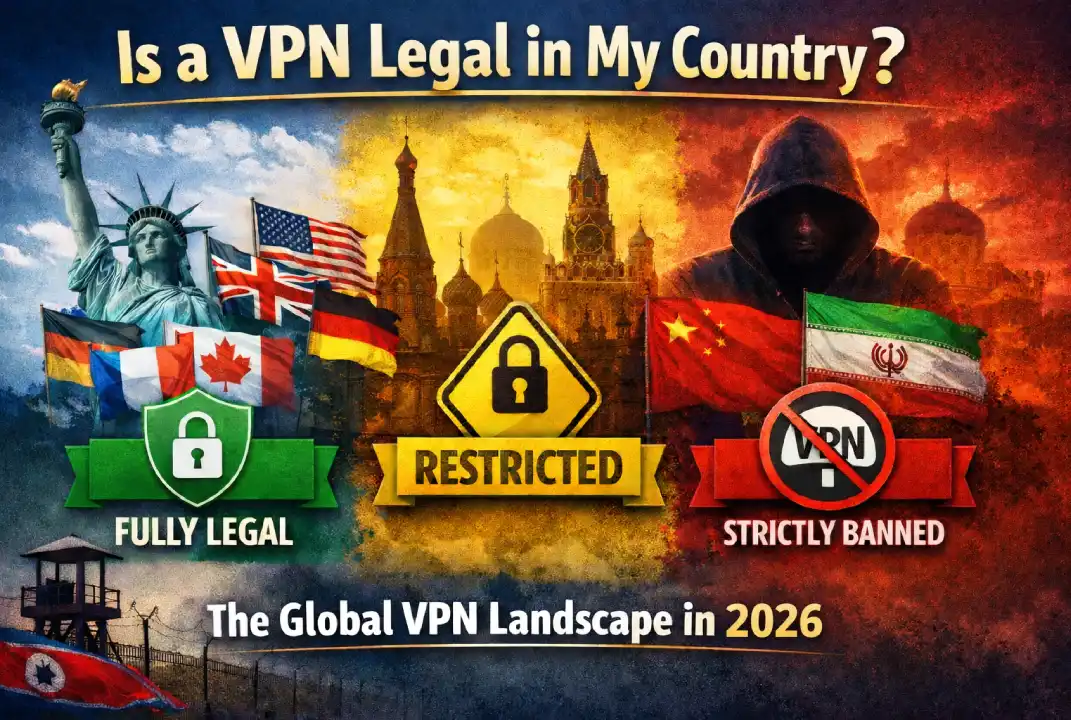
Is a VPN Legal
In My Country?
Virtual Private Networks (VPNs) are foundational tools for online privacy. But legality varies wildly depending on your global coordinates. Ironically, the jurisdictions that require VPNs the most are often the ones actively attempting to outlaw them. Here is the definitive 2026 breakdown.
The 2026 Global Matrix
A high-level overview of global cryptographic routing legality.
Fully Legal
🇺🇸 USA, 🇨🇦 CAN, 🇬🇧 UK, 🇩🇪 GER, 🇫🇷 FRA, 🇦🇺 AUS, 🇧🇷 BRA
No restrictions. Widely deployed for privacy and geo-unblocking.
Restricted
🇮🇳 India, 🇷🇺 Russia, 🇹🇷 Turkey, 🇦🇪 UAE, 🇸🇦 Saudi Arabia
Legal to possess, but heavily monitored, throttled, or penalized if used against state filters.
Strictly Banned
🇨🇳 China, 🇮🇷 Iran, 🇰🇵 North Korea, 🇧🇾 Belarus, 🇴🇲 Oman
Outlawed for individuals without explicit state permits. Severe legal penalties apply.
🟢 The Open Web: Fully Legal
In these jurisdictions, VPNs are treated as standard, necessary cybersecurity tools.
The Legal Framework
These nations impose absolutely no restrictions on VPN usage. Governments and federal agencies actively recommend them for securing data on public Wi-Fi networks. While utilizing a VPN to commit cybercrimes remains illegal, the cryptographic technology itself is entirely protected.
Public Adoption
Adoption rates are massive. In the U.S. alone, roughly 46% of internet users have deployed a VPN. Citizens primarily use them to block ISP data harvesting, evade targeted advertising, secure remote work connections, and bypass streaming geo-blocks.
🟡 The Gray Zones: Legal but Restricted
Having a VPN app won’t result in an arrest, but governments actively throttle, block, or fine circumventors.
🇮🇳 India
The Law: A 2022 directive mandates that VPN providers operating physical servers in India must log user data for 5 years. This violates “no-logs” policies, forcing premium providers to route traffic virtually.
🇦🇪 UAE & 🇸🇦 Saudi Arabia
The Law: Corporate VPNs are legal. Personal VPNs are heavily monitored. Using a fraudulent IP to access blocked services (like WhatsApp calling or gambling) incurs catastrophic fines up to $545,000.
🇷🇺 Russia & 🇹🇷 Turkey
The Law: Not technically a crime for individuals, but states actively wage war on the infrastructure. Russia requires VPNs to tie into its censorship grid. Turkey blocks VPN endpoints during civil unrest.
🇮🇩 Indonesia
The Law: Legal, but tightening. The government maintains a massive blocklist of over 800,000 sites and actively attempts to block “free VPN apps” at the network level to enforce moral bans.
🔴 The Dark Zones: Strictly Banned
VPN usage by ordinary citizens is treated as a severe criminal offense, resulting in extortionate fines or imprisonment.
🇨🇳 China
The Law: All unauthorized VPNs are illegal. The “Great Firewall” utilizes deep packet inspection to sever encrypted connections. Fines for using unauthorized VPNs can exceed $140,000.
🇮🇷 Iran
The Law: The Supreme Council of Cyberspace formally outlawed the possession of circumvention tools. The state is actively building a closed “National Information Network” intranet.
Absolute Blackout Territories
-
🇰🇵 North Korea: Global internet access is completely banned for citizens. The nation operates on a closed intranet.
-
🇹🇲 Turkmenistan: Citizens must sign pledges swearing they will never use a VPN, under threat of prosecution.
-
🇴🇲 Oman: Strict enforcement. Personal use is outlawed; individuals caught face immediate $1,300 fines.
Final Diagnostics: 2026
For the vast majority of the free world, VPNs are completely legal and recognized as essential tools for digital hygiene. However, if you are traveling to nations with heavy censorship, you must install and update your VPN protocols before crossing the border.